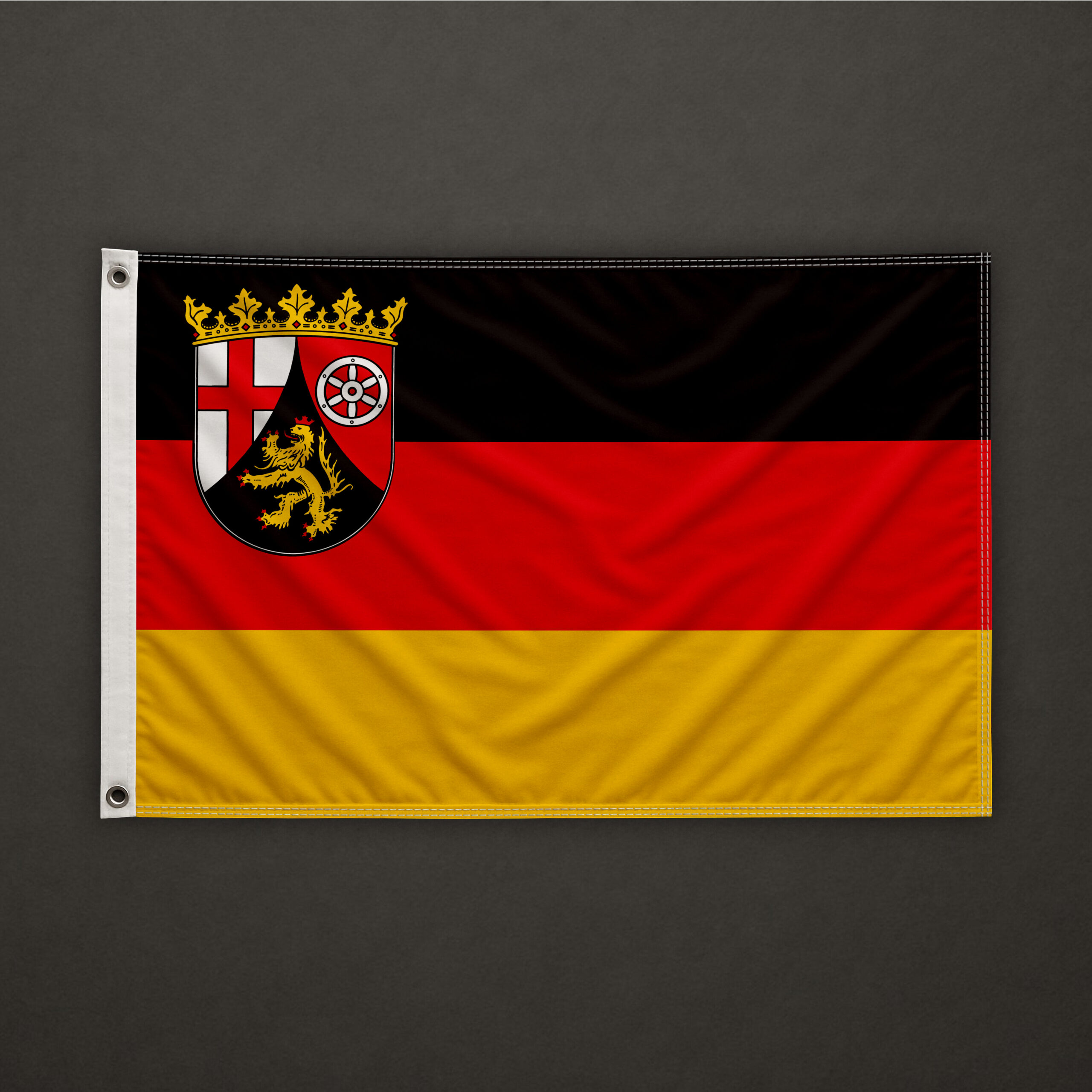
Black, red and gold, with the arms in the corner: Rhineland-Palatinate
This flag has three horizontal bands, black, red and gold, with the arms of the state in the top corner next to the pole: a crowned shield in three parts, with a red cross on white, a white wheel on red and a golden lion on black.
What the article says
According to the English Wikipedia article, the flag is a tricolour of black, red and gold bands with the state arms in the upper hoist corner. It is the civil and state flag of the state, was adopted on 10 May 1948 and has the proportion 2:3.
Three electors
The arms are divided in three parts, one for each of the powers that dominated the region before the French Revolution: the red cross on silver for the Archbishop and Elector of Trier, the silver wheel on red for the Archbishop and Elector of Mainz, and the crowned golden lion on black for the Elector of the Palatinate.
Vine leaves and a young state
The crown of the arms is a golden 'people's crown' of vine leaves, which, English Wikipedia says, shows the importance of this crop for local agriculture. The arms were designed in 1947 together with the state flag, when the new state was formed under the French authorities. English Wikipedia says these colours were first seen in this combination at the Hambach Festival of 1832, a mass demonstration by German liberals, and that the Palatinate is therefore connected to them.
Who chooses it
For anyone from Mainz, Koblenz, Trier, Ludwigshafen or Kaiserslautern, or with roots on the Rhine, the Moselle or in the Palatinate; for winegrowers and wine lovers; for those who live far away and carry their state with them; for clubs, associations, supporters and local businesses. We sew it to order, in the size and fabric you choose above, and you see the delivery date before you pay.