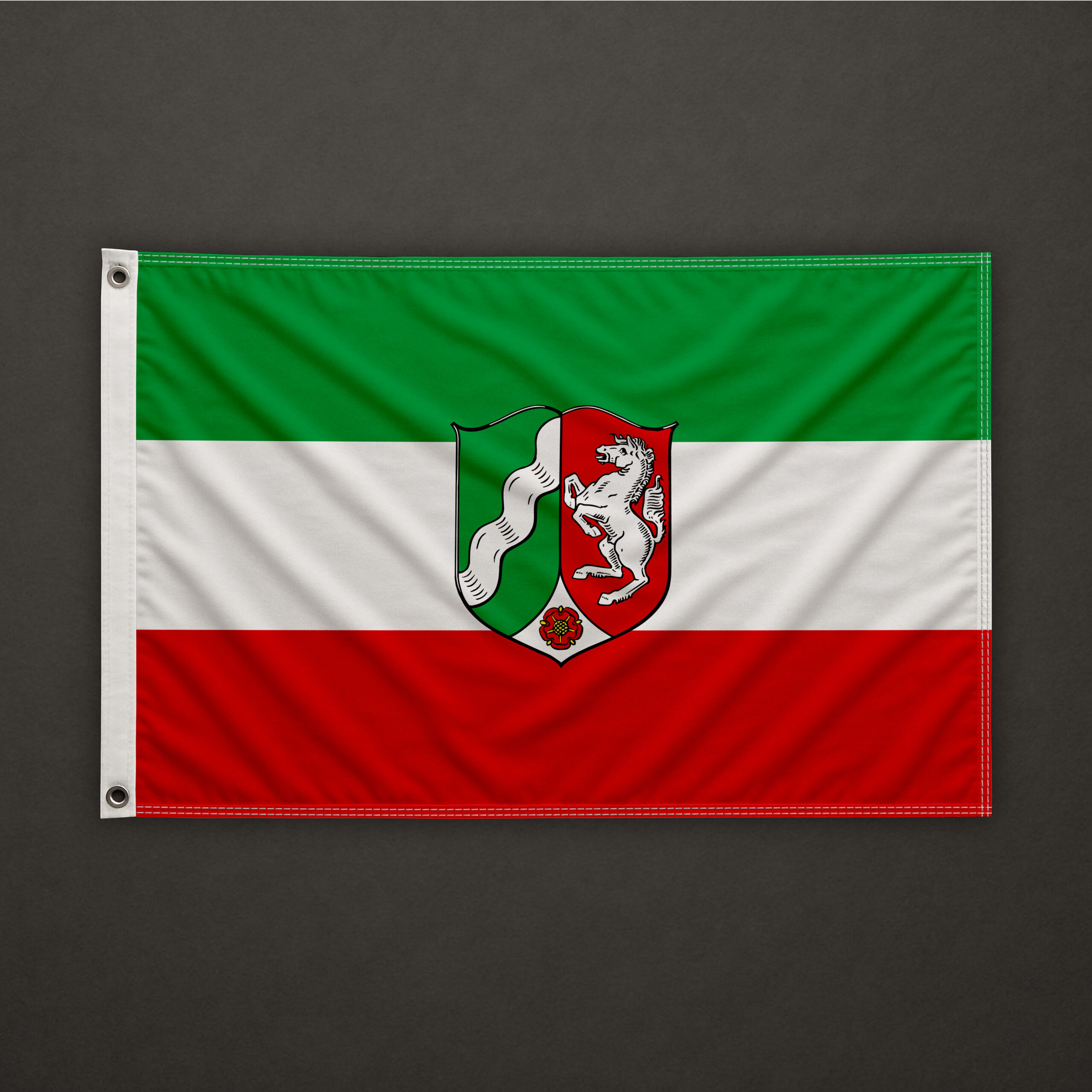
Green, white and red, with the state arms
This flag has three horizontal bands, green, white and red, with the state arms in the centre: a shield divided in three, with a white wavy band on green, a white rearing horse on red and a red rose on white.
What the law says
According to the German Wikipedia article, the Law on the State Colours, the State Arms and the State Flag of 10 March 1953 fixes the colours as green, white and red, and describes the flag as three equal bands, green at the top, white in the middle and red at the bottom, with the height to the length as 3 to 5. The service flag is the state flag with the state arms in the centre, shifted slightly towards the hoist.
Three regions in one shield
The arms combine the emblems of three regions: the Rhine for the Rhineland, the Saxon horse for Westphalia, and the Lippe rose for Lippe, which joined the state in 1947. The colours work the same way: green and white for the Rhineland, white and red for Westphalia.
How it was made
On 23 August 1946 the British military administration set up the state by merging Westphalia with North Rhine; the Free State of Lippe was added in January 1947. The arms were designed by the heraldist Wolfgang Pagenstecher in 1947 and adopted by the state on 5 February 1948; the law of 1953 confirmed them.
Who chooses it
For anyone from Cologne, Düsseldorf, Dortmund, Essen or Münster, or with roots in the Rhineland, Westphalia or Lippe; for those who live far away and carry their state with them; for clubs, associations, supporters and local businesses. We sew it to order, in the size and fabric you choose above, and you see the delivery date before you pay.