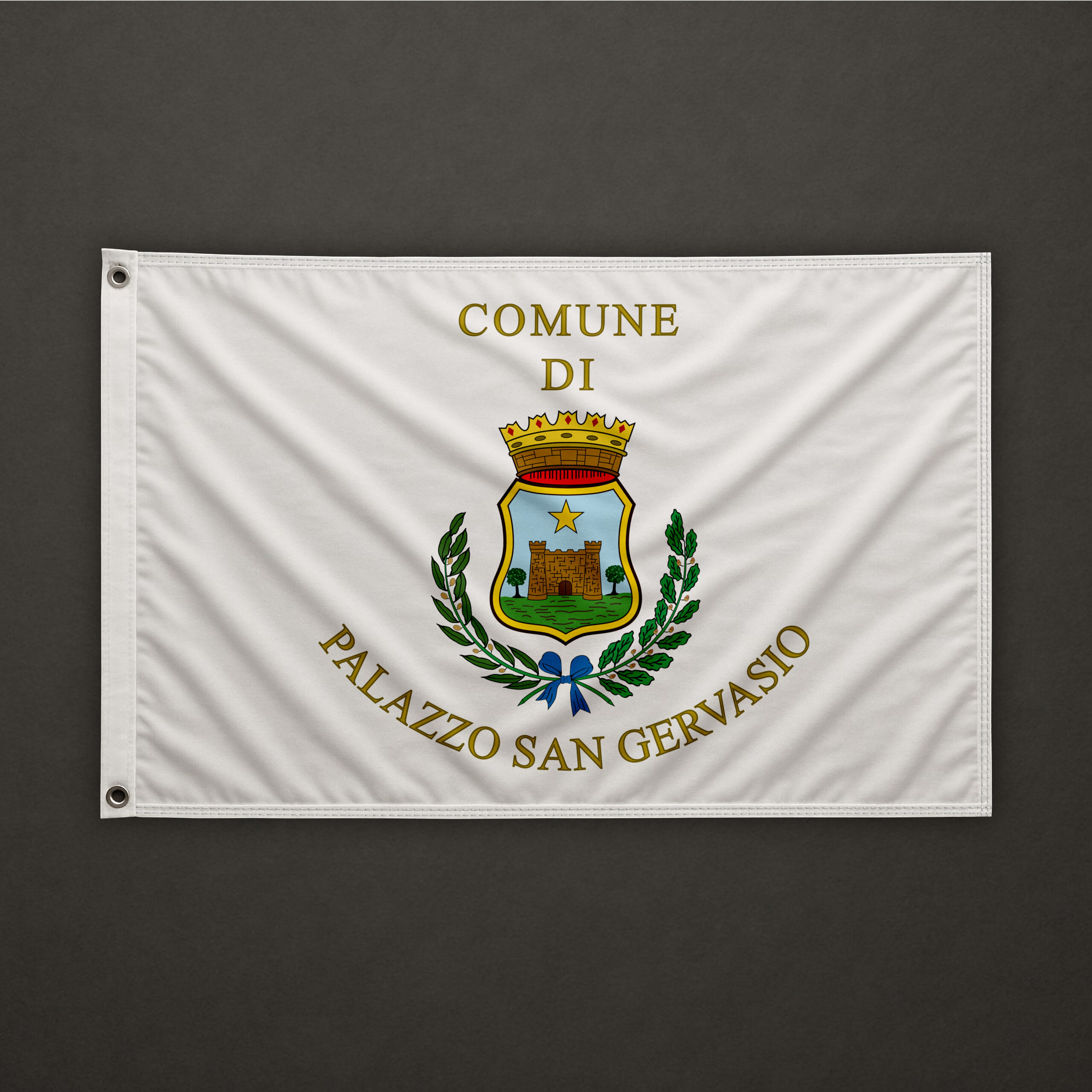
White, with the arms and the name of the town: the flag of Palazzo San Gervasio
This flag is a plain white field. The words COMUNE DI stand in gold at the top, and just below them a gold city crown sits over a medallion-shaped shield: a star in a pale blue sky, and a brown castle with two round towers between two trees on a green meadow. Two leafy branches tied with a blue ribbon frame it, and PALAZZO SAN GERVASIO curves in gold letters beneath.
What the Statute says
Article 2 of the Statute of the Comune of Palazzo San Gervasio describes the arms: a medallion with, at the centre, a frontal castle with two cylindrical towers with Guelph battlements, a pine on each side, and above all, in the blue area, a five-pointed star. Below, an oak branch with green leaves and acorns on one side and a cornel branch with green leaves and berries on the other, held together by a blue ribbon. It describes the gonfalone as a white cloth with the words «Comune di» in gold, the arms just below them, and at the bottom, in a half-elliptical arc, «COMUNE DI PALAZZO SAN GERVASIO» in gold letters. This flag follows that layout.
The palace of the Normans
Italian Wikipedia says the town was called simply Palazzo until 1863, and that «San Gervasio» honours the saint of a small church in the village of Cervarezza. The first written source dates from 1082, and the settlement was probably the Palatium built by Robert Guiscard around 1050. The castle, the Palatium Regium, was originally square, in the Norman military style, with two corner towers, now destroyed. Its renovation, the page says, was almost certainly carried out to a design of Frederick II.
Horace's spring and a gift of art
Scholars regard the local waters as historic, including the Fons Bandusiae celebrated by Horace. In 1799 the town was among the first to plant a Liberty Tree and join the Neapolitan Republic, and in 1897 Camillo d'Errico bequeathed to the town an art collection of 298 canvases, 500 prints and 8,000 books. The town is in the province of Potenza, in north-eastern Basilicata; the patron saint is Sant'Antonio da Padova, on 13 June.
Who chooses it
For anyone from Palazzo San Gervasio, for those who live far away and carry their town with them, for the Comune, its offices and civic ceremonies, for schools, associations and clubs, for lovers of the Norman and Swabian castles of Basilicata, for a restaurant, a shop or a business that wants to show where it belongs. We sew it to order, in the size and fabric you choose above, and you see the delivery date before you pay.