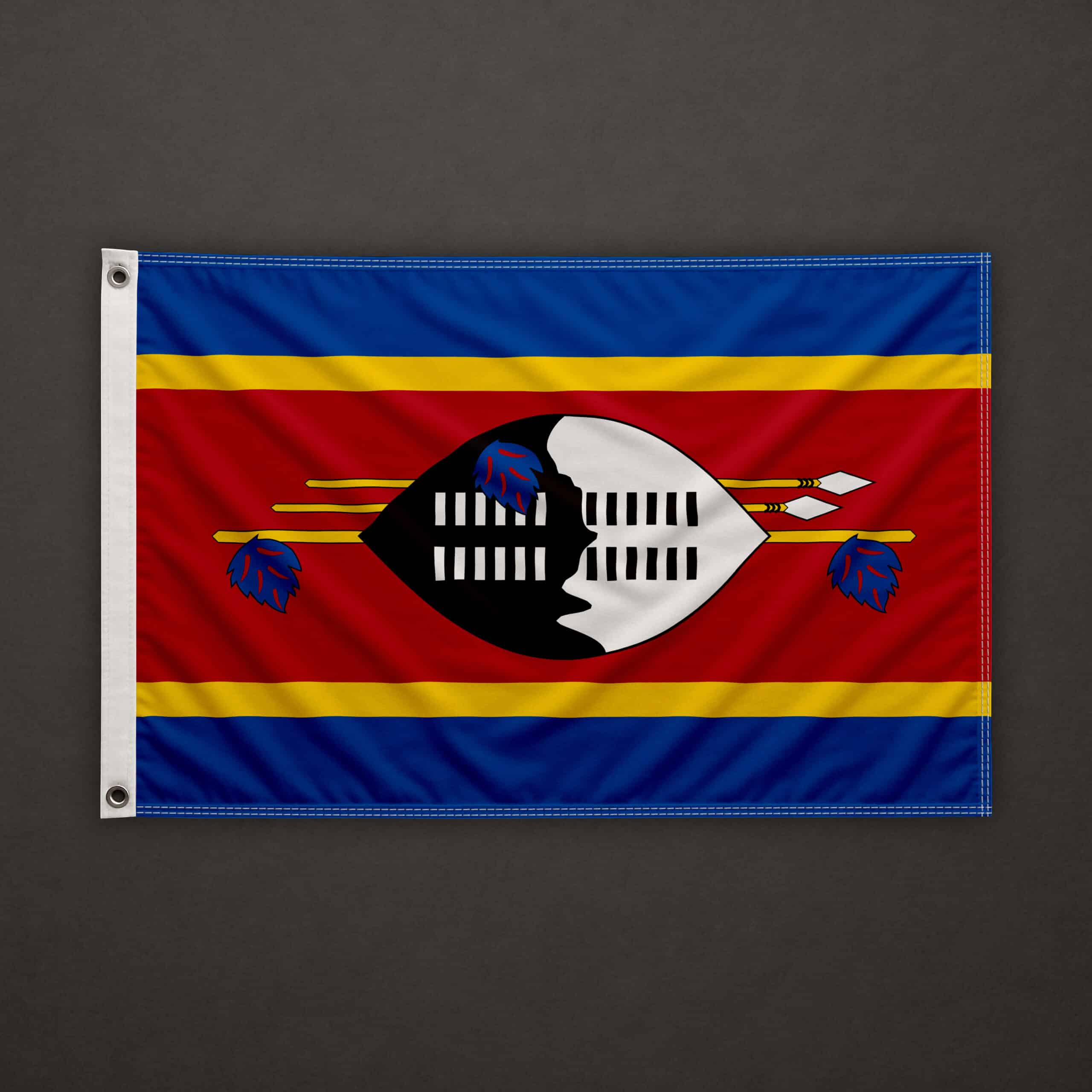
The warrior's shield: the flag of eSwatini (formerly Swaziland)
The flag of eSwatini, the country called Swaziland until 2018, has five horizontal bands: blue, yellow, crimson, yellow and blue. At the centre of the wide crimson band lies a Nguni shield of ox hide, black and white, set sideways as when it is carried walking, in front of two spears and a staff decorated with feather tassels.
A black and white shield
The shield is that of the Emasotsha regiment, and behind it the two spears point towards the fly of the flag. The feather tassels of the widow bird and the lourie are an ornament reserved for the king. In the most widespread reading, the shield and spears stand for the protection of the country from its enemies, and the black and white of the shield tell of different peoples living together in peace.
The colours of the Swazi flag
Crimson recalls the battles of the past, yellow the mineral wealth of the country, blue peace and stability. Simple colours that can be read from afar, and a shield that makes it unmistakable.
Sewn by three princesses
The story of the flag begins in 1941, during the Second World War. The Swazi Pioneer Corps was preparing to leave with the Allied forces for the invasion of Italy, and King Sobhuza II had three princesses sew a special banner for the unit: blue, yellow and maroon stripes, the Swazi war shield, two spears and the staff with tassels. Today's flag grew out of that banner.
From 1967 to eSwatini
The flag was raised for the first time on 25 April 1967, in place of the British Union Jack, and registered on 30 October that year with a few artistic touches. On 6 September 1968, Independence Day, it stayed the same, and a law of that same year fixed it for good. In 2018, for the fiftieth anniversary of independence, King Mswati III announced the country's new name, eSwatini, which means «land of the Swazi».
Who chooses it
For anyone with Swazi roots living in Italy or Europe, for Southern African associations, for fans of the national team, for schools and multicultural festivals, for anyone who has travelled among eSwatini's mountains and reserves, for a restaurant or a shop, for flag collectors and Model UN participants. We sew it to order, in the size and fabric you choose above, and you see the delivery date before you pay.