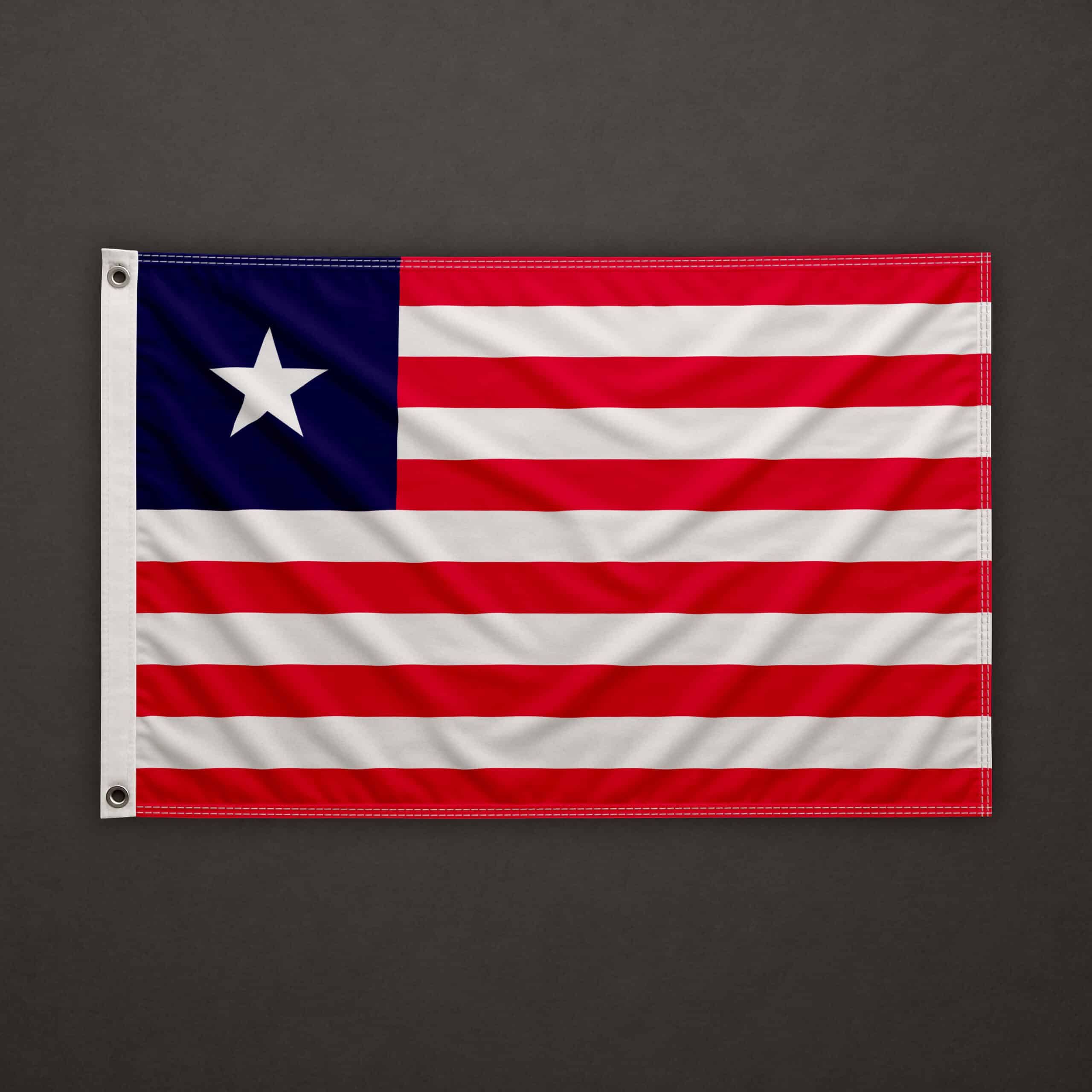
Eleven stripes and a single star: the flag of Liberia
The flag of Liberia has eleven horizontal stripes, six red and five white in alternation, and at the top next to the staff a blue square with a large white five-pointed star. The Flag Law of 1961 puts it precisely: eleven red and white stripes, the first and the last red, a square blue canton and a large star in the exact centre of the blue. Liberians call it the «Lone Star».
A land named after freedom
Liberia was born from a colony founded on the coast of West Africa by the American Colonization Society, an association set up in the United States in 1816 to help freed slaves return to Africa. The name comes from the Latin «liber», free. On 9 April 1827 the colony received its first flag: thirteen red and white stripes, like the American one, and a white cross in the blue canton.
1847, independence
On 26 July 1847 Liberia proclaimed its independence. The new flag was entrusted to a committee of women, chaired by Susannah Lewis, which sewed it: in place of the cross they put a star, the symbol of Liberia as the only independent Western-style state in Africa, and the stripes went down to eleven. The flag was raised for the first time on 24 August 1847, a day that is still Flag Day.
What it tells
The eleven stripes recall the eleven signatories of the declaration of independence. The 1961 law also gives the colours a meaning: blue, which must be navy blue, stands for liberty, justice and fidelity; pure white for purity; ruby red for steadfastness, valour and fervour.
Likenesses and differences
The Liberian flag openly draws on that of the United States, where the founders came from, but it has a story all its own: in more than a century and a half the design has never changed. It flies on 26 July, the anniversary of independence, on 24 August, and every time the national team takes the field.
Who chooses it
For people with roots in Liberia living in Italy or in Europe, for Liberian communities and associations, for national team fans at the Africa Cup of Nations, for schools and multicultural festivals, for those who study African and American history, for a restaurant or shop, for collectors of world flags and for model UN delegates. We sew it to order, in the size and fabric you choose above, and you see the delivery date before you pay.