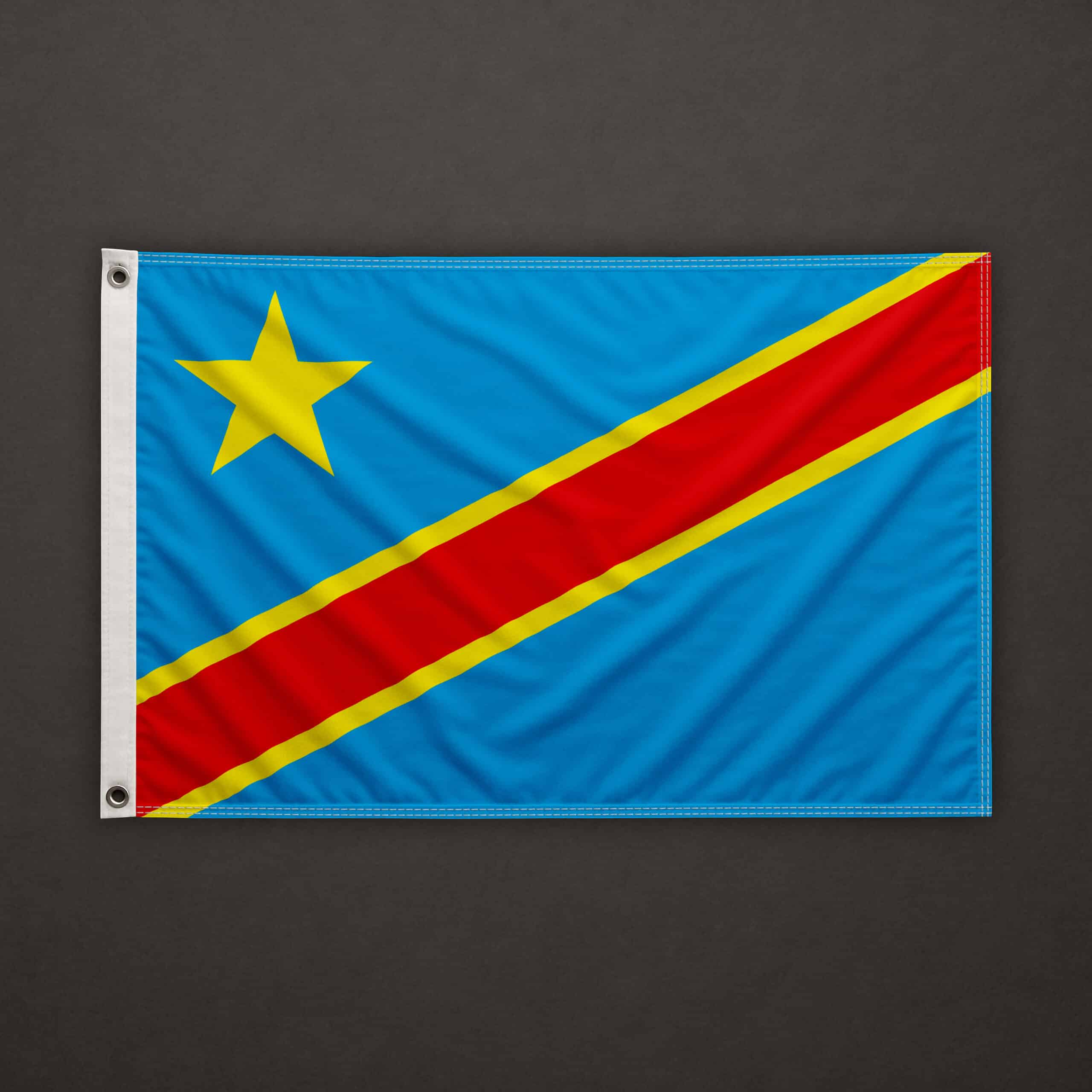
Sky blue, yellow star and red band: the flag of the Democratic Republic of the Congo
The flag of the Democratic Republic of the Congo is a sky-blue field crossed diagonally, from the lower corner by the pole to the upper outer corner, by a red band edged in yellow. In the upper corner next to the pole is a large yellow star. It is a flag full of momentum, with a story that spans more than a century.
The star on the blue
The blue with the golden star is the oldest motif of the Congolese flag. According to Encyclopaedia Britannica it goes back to 1877, when it was the flag of the association that a few years later proclaimed the Congo Free State, under the control of King Leopold II of Belgium. The United States was the first to recognise that state and its flag.
From 1960 to today
On 30 June 1960 the Congo became independent, and six yellow stars appeared along the hoist of the blue flag, one for each of the six provinces. In 1963 came the design with the diagonal red band and the large star in the corner. From 1971, when the country took the name of Zaire, the flag was green with a yellow disc, an arm and a torch. In 1997 the blue flag of independence returned.
The return of 2006
On 18 February 2006, with the new Constitution, the Democratic Republic of the Congo took up again the design of the 1960s with the diagonal red band, but with a lighter blue. It is today's flag, and the Constitution describes it in Article 1: the sky-blue flag, adorned with a yellow star in the upper left corner and crossed diagonally by a red band finely edged in yellow.
Peace, blood, wealth, future
According to press reports at the time of its adoption, collected by the Flags of the World archive, the blue symbolises peace, the red the blood of the country's martyrs, the yellow its riches and the star a radiant future. Beside the flag, the Constitution sets the national motto: «Justice, Paix, Travail», justice, peace, work.
Who chooses it
For Congolese people and anyone with roots in the Democratic Republic of the Congo, for the families and associations of the Congolese community in Italy, Belgium and across Europe, for the independence celebration on 30 June, for fans of the national team at the Africa Cup of Nations, for schools and multicultural festivals, for anyone who has worked in development or missions in Central Africa, for a collector or a model UN. We sew it to order, in the size and fabric you choose above, and you see the delivery date before you pay.