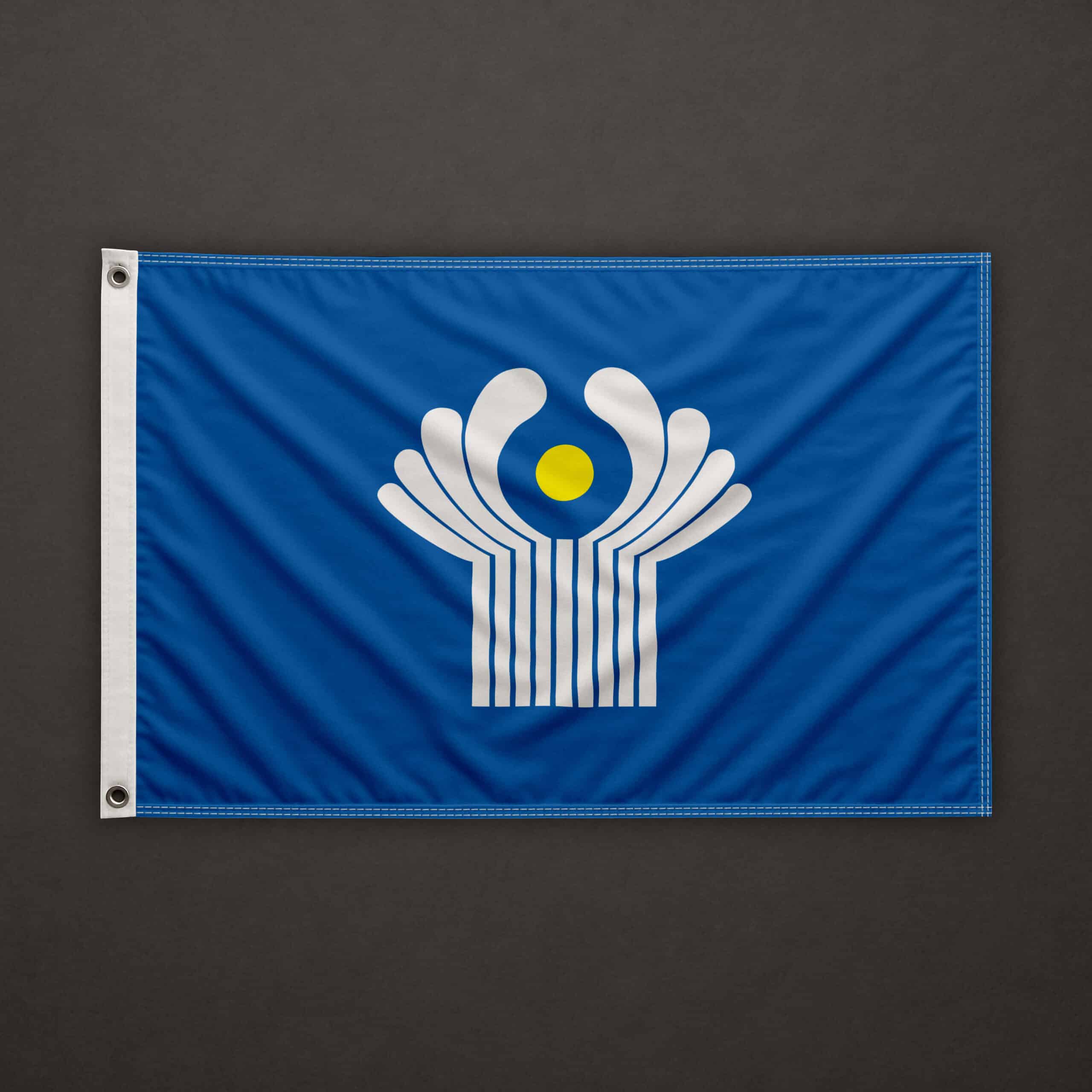
Blue, white and a golden sun: the CIS flag
The flag of the Commonwealth of Independent States, the CIS, is a blue field with, in the centre, a white figure made of vertical bars which, as they rise, open to the right and left into rounded rings, like branches or like two hands opening. At the top, held between the rings, is a golden circle. It is the flag of an international organisation born at the end of the Soviet Union and still active today.
How the Commonwealth was born
On 8 December 1991 the elected leaders of Russia, Ukraine and Belarus signed an agreement to create a new association to take the place of the Soviet Union. In the following weeks other former Soviet republics of Central Asia and the Caucasus joined, and the Commonwealth formally came into being on 21 December 1991, with its administrative centre in Minsk, Belarus.
A competition for the symbol
At the beginning of 1994 the Commonwealth announced a competition for the flag and the emblem. The winner was the artist Alexander Grigoryev of Saint Petersburg, and on 15 April 1994 the Commonwealth's council accepted his designs. The symbol came into use even before it had been finally approved.
The statute of 1996
The flag was set down by the Statute on the Flag of the Commonwealth of Independent States, signed in Moscow on 19 January 1996. The statute describes it like this: a blue field with, in the centre, a white figure of vertical bars which open at the top into ring-shaped elements, and a golden circle surrounded by those rings. The statute also provides that the flag is used by the collective peacekeeping forces during their operations.
The meaning of the design
The statute says the design expresses the aspiration for equitable partnership, unity, peace and stability. According to the Commonwealth's Executive Committee, the golden circle can be read as a symbol of warmth and light and of the peoples' lasting values, and a newspaper of the time described the flag as a sun among many open hands.
Who chooses it
For a collector of the flags of international organisations, for anyone passionate about twentieth-century history and the end of the Soviet Union, for a school or university studying international relations, for a conference, an exhibition or a museum, for a film or theatre set, for associations and communities from the countries of the former Soviet Union. We sew it to order, in the size and fabric you choose above, and you see the delivery date before you pay.