
Purple, white and green: the genderqueer pride flag
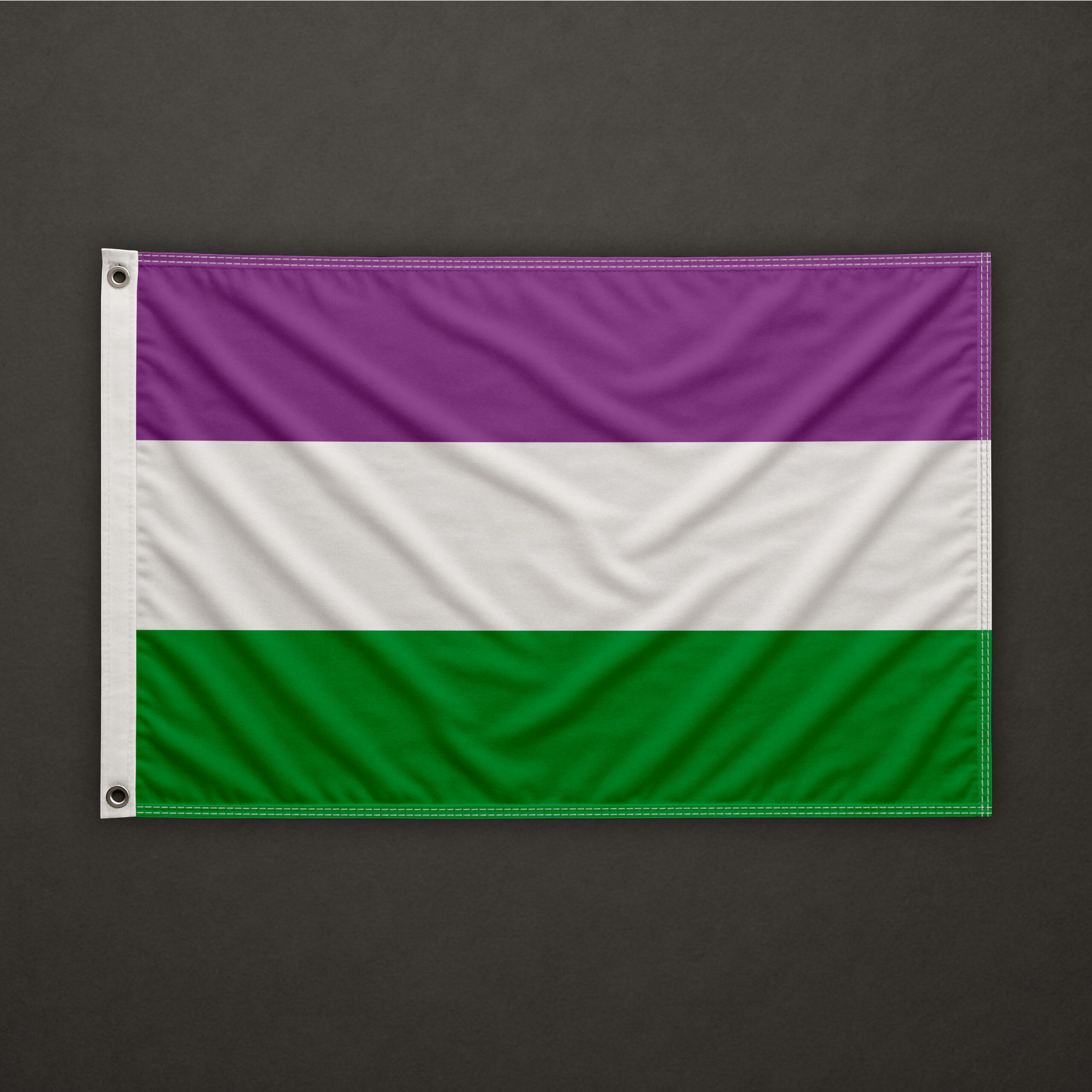
This flag has three horizontal stripes of equal height: purple on top, white in the middle and green at the bottom.
Your configuration
| Pieces | Discount | Each |
|---|---|---|
| 1–2 | — | |
| 3–9 | −15% | |
| 10–19 | −19% | |
| 20–49 | −23% | |
| 50–99 | −27% | |
| 100–249 | −31% | |
| 250–499 | −34% | |
| 500–999 | −36% | |
| 1000–2499 | −38% | |
| 2500–4999 | −39% | |
| 5000–7499 | −39,5% | |
| 7500+ | −40% |
At your door Monday 30 November — Standard
Order within 21 h 27 min to keep this date
On time, or we pay
Express late: full refund, the flags are yours
Standard/Economy late: 10% back as store creditWe pay, automatically. Express late — a full refund, and the flags are yours. Standard or Economy late — 10% of the order back in My Wallet. You do not have to ask. Read more: What if we deliver late?
Configure the product to view the blueprint
Express lane capacity
| Dimensions | Dimensions 150 x 100 cm (width x height). Standard ratio between height and width: 2:3. |
|---|---|
| Material | Our standard outdoor flag fabric, and the one most customers choose. 100% polyester, 115 g/m², tightly knitted with no mesh holes, so colours stay bright and the flag dries quickly after rain. Resistant to sunlight, suitable indoors and outdoors. Machine washable at 30°C. |
| Printing | Printed straight onto the fabric with CMYK disperse dyes made for polyester. A special coating carries the colour right through the weave, so the back looks the same as the front. The colours are fixed with heat at 185°C, which makes them washable and slow to fade. |
| Finishing | Along the hoist side, a 40 mm polyester band is folded double and sewn with two rows of stitching. A 6 mm rope forms a loop at the top corner and hangs free for about 40 cm at the bottom, ready to tie to a pole. |
Description
This flag has three horizontal stripes of equal height: purple on top, white in the middle and green at the bottom.
English Wikipedia describes genderqueer as a gender identity outside the male/female binary, often used as an umbrella term for gender-nonconforming identities. The term appeared in queer zines of the 1980s and early 1990s, and gained prominence in the mid-1990s through activists such as Riki Anne Wilchins; the anthology «GenderQueer: Voices From Beyond the Sexual Binary» spread it further in 2002.
Wikipedia and the San Francisco Gay Men's Chorus guide both say the flag was designed in 2011 by the artist and activist Marilyn Roxie; Wikimedia Commons credits the design to her too.
Lavender represents androgyny or queerness, white represents agender identity, and green represents those whose identities are defined outside the binary. Wikipedia also notes that the lavender in the genderqueer and non-binary flags refers to LGBTQ+ history, as the word lavender had long been used for the gay community.
For genderqueer and non-binary people, their families, friends and allies, for pride marches, student groups and community centres, and for anyone who wants this flag on a balcony, in a window or at an event. We sew it to order, in the size and fabric you choose above, and you see the delivery date before you pay.
Chosen for , your «Deliver to» address.
Do you hold rights to this design? Report it
The delivery dates you see are for . Tell us your country and postcode and every date on the site becomes yours.
Prices, sizes, delivery, your orders: answers in seconds, day and night.
Your browser will ask to use the microphone. Speak normally — you can interrupt at any time.
Call in progress… One moment, we are connecting you.
00:00During the call, links on the site open in a new tab, so the conversation continues here.
I do not have access to the microphone. Enable it for this site in your browser settings to talk to the assistant.
Coming soon, right here. In the meantime, call us or message us on WhatsApp.