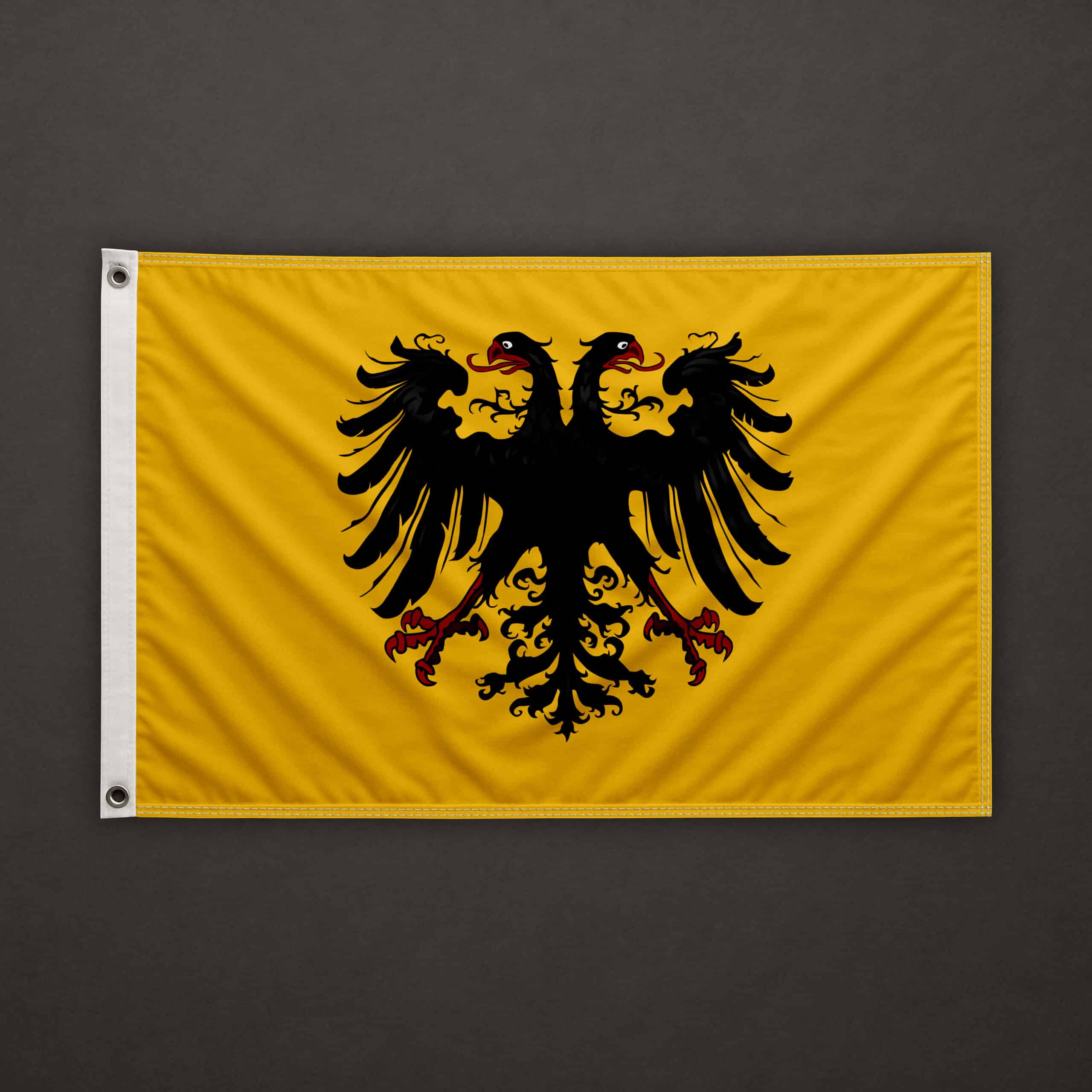
Gold and the double-headed eagle: the Holy Roman Empire flag
The Holy Roman Empire flag is a gold field with a black two-headed eagle in the centre, with red beaks and talons. It is the imperial banner as vexillologists show it for the centuries from 1400 onwards: an image that for almost a thousand years of European history meant one thing only, the emperor.
The emperor's banner
The Holy Roman Empire had no national flag as we understand it today. What existed was the emperor's banner: a black eagle, armed red, usually on a gold field. Sometimes the same eagle appears on a white field, and a flag chart from the early eighteenth century gives the yellow one to the emperor and the white one to the empire, but it is not certain that the distinction was real.
From Charlemagne to 1806
Its story begins with Charlemagne, crowned «emperor of the Romans» by Pope Leo III in the year 800. For ten centuries the title passed to Frankish and then German kings, over a set of lands in central and western Europe that included parts of what are today Germany, France and Italy. The expression «Holy Roman Empire» appears in documents from 1254.
From one head to two
In the early centuries the eagle on the banner had a single head. After 1400 it became double-headed, perhaps following the example of the Byzantine Empire, the other great claimant to the legacy of Rome. Over time the eagle often gained a sword, an orb and a crown, and there were versions with haloes around the heads and versions without, like this one. Some emperors added the arms of their own house on its breast.
The end and the legacy
In 1806, faced with the rise of Napoleon, Emperor Francis II laid down the title and the empire came to an end. Two years earlier he had proclaimed himself Emperor of Austria, and the first flag of the Austrian Empire was black and gold, in the colours of the imperial banner. Black and gold long remained the colours of the Habsburgs.
Who chooses it
For a collector of historic flags, for anyone who loves the Middle Ages and European history, for a historical re-enactment group or a company of arms, for a palio, a joust or a medieval festival, for a castle or a museum, for a school, for a film or theatre set, for a themed venue. We sew it to order, in the size and fabric you choose above, and you see the delivery date before you pay.